
What Are Carrier Oils? A Beginner's Guide to Choosing and Using Them (Australia)
Share
Quick answer: Carrier oils are plant oils — cold-pressed from seeds, nuts or kernels — used to dilute essential oils and apply them safely to skin, or used on their own for skin and hair care. They are called carrier oils because they literally carry other ingredients onto the skin. Common examples include jojoba, sweet almond, rosehip, argan and fractionated coconut oil.
Why are they called carrier oils?
The name comes from aromatherapy: essential oils are too concentrated to apply to skin directly, so they are blended into a carrier oil that dilutes them and delivers (or carries) them safely. The term has stuck, even though carrier oils are widely used on their own as standalone skin and hair products — no essential oil required.
How are carrier oils made?
Most quality carrier oils are cold-pressed: the seeds, nuts or kernels are mechanically pressed to extract the oil without using heat. Cold-pressing preserves more of the oil's natural fatty acids, vitamins and antioxidants compared to heat extraction or solvent extraction. This is why "cold-pressed" appears on quality carrier oil labels and is worth looking for when you buy.
How are carrier oils different from essential oils?
| Property | Carrier oils | Essential oils |
|---|---|---|
| Concentration | Ready to apply to skin | Highly concentrated — must be diluted |
| Evaporation | Do not evaporate (non-volatile) | Evaporate quickly (volatile) |
| Scent | Mild or none | Strong, characteristic scent |
| How extracted | Cold-pressed from seeds/nuts | Steam distilled or cold-pressed from plant matter |
| Feel on skin | Oily or waxy texture | No oily feel — evaporate on contact |
What do carrier oils actually do?
Carrier oils are primarily used for their physical properties rather than active therapeutic effects. They moisturise skin by reducing water loss from the surface, soften and condition hair by coating the shaft, and provide a medium for blending and applying other ingredients. Some carrier oils have additional properties — rosehip is high in linoleic acid and vitamin A precursors associated with skin renewal; argan is rich in vitamin E and oleic acid; jojoba structurally resembles skin's own sebum.
Common carrier oils and what they suit
- Jojoba oil — technically a liquid wax; lightweight, absorbs well, suits all skin types including oily. Good all-purpose choice for skin and scalp.
- Sweet almond oil — light to medium weight, mild scent, good for sensitive and dry skin. A classic massage oil.
- Argan oil — medium weight, rich in vitamin E, popular finishing oil for hair and a good dry-skin face oil.
- Rosehip oil — lightweight, high in linoleic acid and vitamin A precursors. Popular for facial use, pigmentation and mature skin.
- Fractionated coconut oil — very light, stays liquid, long shelf life, nearly odourless. Excellent for blending and massage.
- Castor oil — very thick, high in ricinoleic acid. Used as a conditioning pre-wash treatment for hair. Usually blended with a lighter oil.
- Avocado oil — rich and heavy, high in oleic acid. Good for very dry or mature skin, and as a nourishing hair mask.
How to choose a carrier oil
The main factors to consider are your skin type, the intended use and the texture you prefer.
Skin type
- Oily or acne-prone: choose lighter oils like jojoba or fractionated coconut oil that absorb quickly and are unlikely to block pores.
- Dry or mature: richer oils like argan, avocado or sweet almond provide more nourishment.
- Sensitive: jojoba and sweet almond oil are well tolerated. Always patch test.
- Normal or combination: most carrier oils work well. Jojoba and rosehip are popular choices.
Intended use
- Face oil: jojoba, rosehip, argan, marula.
- Body moisturiser: sweet almond, fractionated coconut, avocado.
- Massage: fractionated coconut, sweet almond (light absorption, easy to spread).
- Hair finishing oil: argan, jojoba.
- Pre-wash hair treatment: castor (blended), avocado, argan.
- Diluting essential oils: jojoba, fractionated coconut oil, sweet almond.
What to look for on the label
- Cold-pressed: indicates minimal processing and preserved nutrients.
- Certified organic: means the source plant was grown without synthetic pesticides or fertilisers.
- Single ingredient: the INCI (ingredient) name should match the oil — for example, jojoba oil should list Simmondsia chinensis seed oil as the only ingredient.
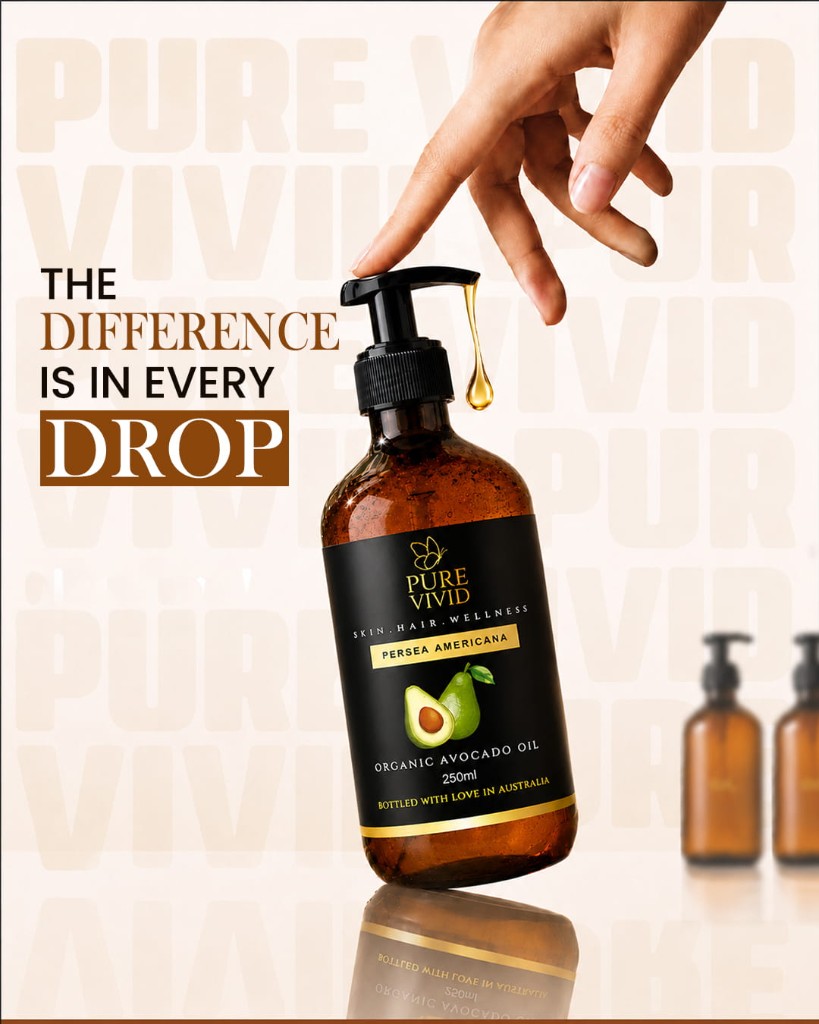
- Dark glass packaging: protects the oil from light degradation. All Pure Vivid carrier oils are bottled in amber glass.
How to store carrier oils
Keep carrier oils in a cool, dark place with the lid tightly closed. Heat, light and air all accelerate oxidation and rancidity. If an oil smells sharp, bitter or paint-like, it has gone rancid and should be replaced. Most carrier oils have a shelf life of 12–24 months, though some (like jojoba) last longer and others (like rosehip or hemp) are more delicate and best used within 6–12 months.
Frequently asked questions
Can I use carrier oils on my face every day?
Many people do, particularly with lightweight oils like jojoba. Start with a small amount and see how your skin responds. If you have acne-prone skin, choose non-comedogenic oils and introduce them slowly.
Do carrier oils expire?
Yes. Follow the best-before date on the bottle and discard if the oil smells off. Storing in dark glass in a cool location extends shelf life.
Are carrier oils the same as cooking oils?
Some plants (like avocado or coconut) produce oils used both in cooking and in skin care. However, cosmetic-grade carrier oils are typically processed differently and are not interchangeable with food-grade oils for skin use.
Can I use carrier oils instead of moisturiser?
Yes, many people do — particularly those with dry skin who prefer a simple routine. Applying a carrier oil to slightly damp skin helps seal in moisture. For very oily skin, a carrier oil alone may not be the right choice.